
How to Find Exact ChatGPT Search Queries in GPT-5 (Thanks to David Konitzny’s Discovery)
By Shad Jafari | Last updated: September 26, 2025
Why ChatGPT Search Queries Matter for SEO
The SEO game is evolving fast. GPT-5 and other large language models (LLMs) are now answering more search queries directly, surfacing AI answers and citations in platforms like Google AI Overviews, ChatGPT, Gemini, and Perplexity. If you know the **exact search queries ChatGPT uses behind the scenes**, you can tailor your content to win these new AI search surfaces and “zero-click” results.
David Konitzny’s Breakthrough
Credit where credit is due: This process was discovered and shared by David Konitzny. With the arrival of GPT-5, David noticed that the internal way ChatGPT passes queries to the search engine had changed—breaking many existing tools. He found that the new method involves the metadata.search_model_queries array in the JSON response, which directly reveals the queries used for any prompt that triggers search.
If you’re in technical SEO, digital PR, or content strategy, this is a game-changer for understanding and optimizing for AI search.
How to Uncover GPT-5’s Exact Search Queries (Step-by-Step Guide)
- Open ChatGPT (GPT-5).
- Enter a prompt that will trigger the search (for example: “What are the best SMS marketing platforms for nonprofits?”).
- Wait for the search to complete.
- Copy the chat URL’s alphanumeric sequence after the
/c/directory. Example:https://chat.openai.com/c/68d13850...— copy68d13850. - Open DevTools: Right-click anywhere and choose Inspect (or press
Ctrl+Shift+I/Cmd+Opt+I). - Go to the “Network” tab. Reload the page. Paste the sequence in the filter box to narrow down traffic.
- Click the relevant JSON file that appears (look for files loading your chat).
- In the Response tab, search for
search_model_queries. - The queries inside the
queriesarray are the exact keywords and questions ChatGPT sent to its search engine to fulfill your prompt.
Screenshot example:
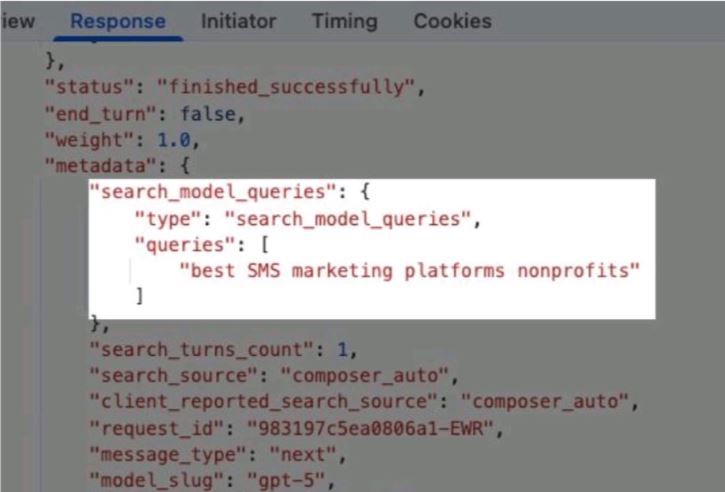
Pro tip: This will often include 1-3 different variations that ChatGPT “fans out” to cover the prompt.
Example: What the Queries Look Like
"metadata": {
  "search_model_queries": {
    "type": "search_model_queries",
    "queries": [
      "best SMS marketing platforms nonprofits"
    ]
  }
}
In this example, the real search query sent is “best SMS marketing platforms nonprofits”. These are often more intent-rich and stripped of filler, showing how AI interprets and condenses user prompts into search-engine language.
How to Optimize Content for AI Search Queries
- Match the query language: Create headings, intros, and snippets that mirror the short, direct style of AI queries (e.g. “best CRM tools for SaaS startups”).
- Answer questions concisely: Use lists, tables, and FAQs to quickly address each likely query variation.
- Implement schema markup: Add FAQ, HowTo, and Product schema so AI models can surface your content as answers and citations.
- Monitor changes: Regularly check how AI models are querying your space and update content as new “fan-out” patterns emerge.
- Stay current: Follow experts like David Konitzny for the latest methods and insights.
By doing this, you’re not just ranking for traditional Google, but positioning your brand and expertise where future traffic flows—across AI chat, voice, and answer engines.
FAQ
Why do GPT-5 search queries matter for SEO?
GPT-5 and similar AI models now serve content directly in chat, AI overviews, and zero-click results. Knowing the exact queries AI uses lets SEOs and creators optimize content to match and win these surfaces.
How do I find ChatGPT’s real search queries in GPT-5?
Use browser DevTools to inspect network traffic after a search, then look for the metadata.search_model_queries array in the JSON response. This reveals the precise queries sent to the search engine.
Who is David Konitzny and what did he discover?
David Konitzny is an SEO expert who discovered that in GPT-5, ChatGPT’s search queries are now output in a new array (metadata.search_model_queries), changing how SEOs extract and analyze AI search intent.
Want more advanced AI SEO tips? Subscribe for updates from Shad Jafari and follow David Konitzny for the latest AI search discoveries!
