
Google Ads Journey Aware Bidding What It Means for Search Campaigns
Google is currently testing a new bidding model called Journey Aware Bidding for Search campaigns. This model marks a major shift in how Smart Bidding will evaluate performance. Instead of focusing on a single primary conversion event, Google Ads will soon be able to consider the full customer journey including all the touch points, signals and interactions that lead to a final conversion.
For advertisers this is a major evolution. Smart Bidding has always been conversion driven. Journey Aware Bidding expands this by allowing secondary actions such as product views, phone calls, form fills and early stage interactions to influence bidding signals in a more meaningful way. In this guide we explore what Journey Aware Bidding is, how it works, why Google is testing it and what advertisers need to do to prepare.
Index
- What is Journey Aware Bidding
- Why Google is introducing it
- How it works
- Impact on search campaigns
- Actions advertisers should take now
- Timeline and rollout
- Frequently asked questions
What is Journey Aware Bidding
Journey Aware Bidding is a new Smart Bidding model created to improve the optimisation of Search campaigns. Instead of relying only on a single final conversion action such as a sale or qualified lead it allows advertisers to define multiple conversion actions across the full funnel. These actions may include early stage events such as viewing a product page requesting a call booking a demo or chatting with support.
The purpose is to train the bidding model to recognise the importance of the interactions that happen before the final sale. Many industries rely on long conversion journeys especially financial services business to business software home services automotive and complex retail categories. Journey Aware Bidding allows Google to use more of the full funnel signals to optimise bids and predict which clicks are likely to lead to meaningful revenue.
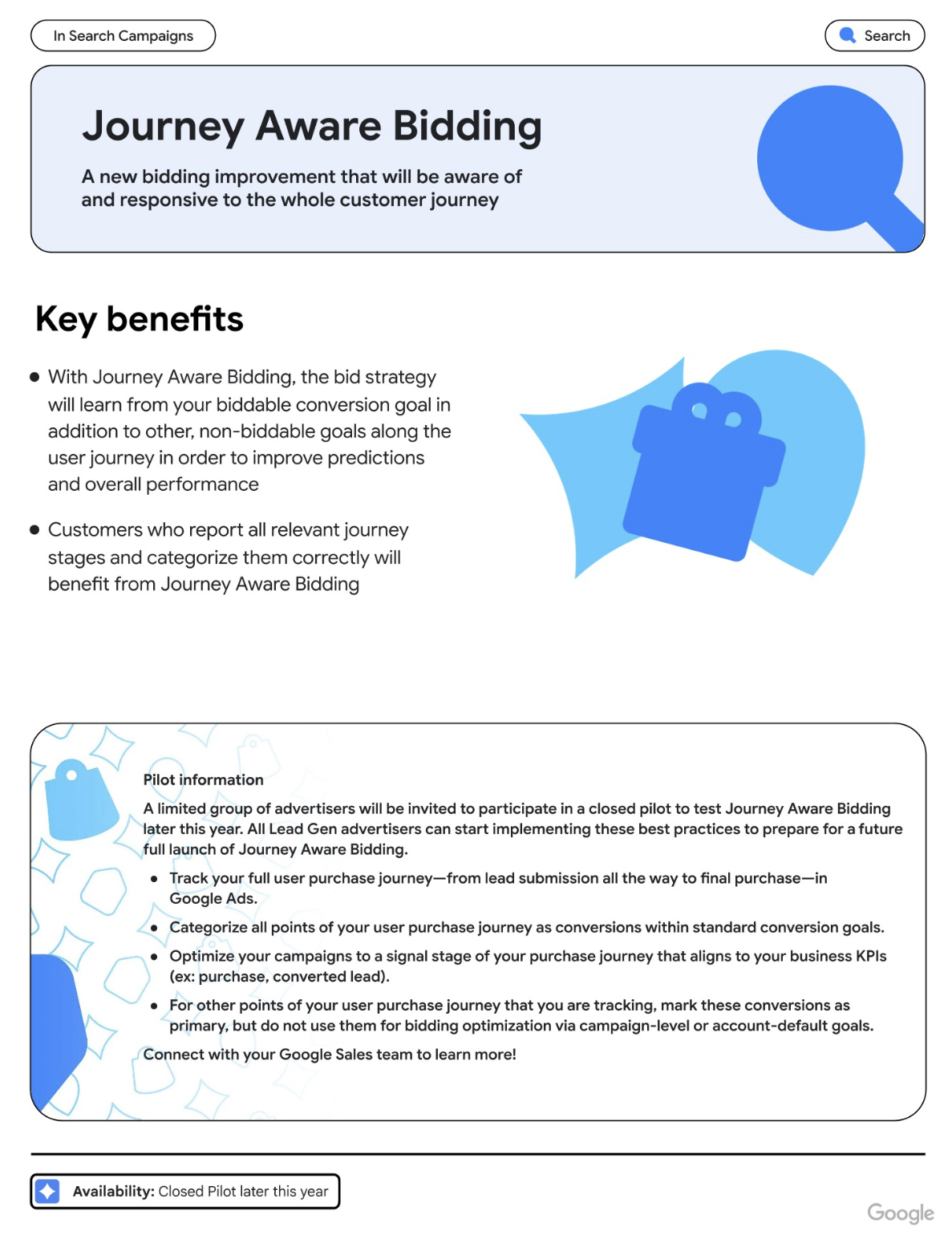
Why Google is introducing it
Google is introducing this model for several reasons.
- Conversion journeys are longer than ever. Few customers buy after one click. Most move through several stages including research comparison and evaluation.
- Advertisers demand more accurate measurement. Many businesses value early stage actions such as qualified leads more than simple form submissions.
- Smart Bidding needs more context to stay effective. With rising competition and signal loss Google needs better signals to optimise campaigns.
- Journey based optimisation aligns with value based bidding. The more Google understands what leads to revenue the better it can guide spending.
How Journey Aware Bidding works
This model uses multiple events in the customer journey to inform bidding decisions. Here is how the process works in practice.
- You import all important conversion actions such as calls sign ups chats demo requests purchases and any other high value events.
- You assign each event a category such as lead qualified lead sales accepted lead or sale.
- You activate Journey Aware Bidding on your Search campaign that uses a Smart Bidding method such as Target CPA.
- The algorithm begins to analyse all journey signals instead of only the last conversion. These signals influence bids on queries audiences devices and contexts.
- The model learns which early interactions predict final conversion and adjusts bids to bring in more of the right users earlier in the journey.
The end result is smarter bidding especially for long funnel advertisers who want to maximise revenue rather than simple conversion count.
Impact on Search campaigns
Journey Aware Bidding has several important implications for advertisers.
- Better alignment with revenue. Because the algorithm sees more of the funnel it can predict which users are likely to convert later.
- Less wasted spend. Poor quality early clicks are identified sooner which improves budget efficiency.
- More dependence on proper conversion tracking. Advertisers must track all stages correctly or the model will not perform.
- Campaign structure may need simplification. Google prefers consolidated campaigns when using complex bidding strategies.
What advertisers should do now
Track every meaningful conversion action
Track calls sign ups add to cart events chats demo requests and all micro conversions across the entire funnel.
Categorise events correctly
Use Google Ads conversion settings to classify events based on their role such as basic lead qualified lead or final sale.
Improve your data quality
Ensure that conversion values are accurate duplicate events are removed and attribution settings reflect your business goals.
Prepare your campaigns for consolidated bidding
Google Smart Bidding performs better with fewer campaigns and cleaner structures.
Timeline and rollout
Google is expected to release Journey Aware Bidding officially in 2026 with limited testing for selected advertisers beginning in late 2025. Lead generation advertisers especially in business to business verticals may gain early access sooner.
Frequently Asked Questions
What is Journey Aware Bidding
It is a new Google Ads bidding model that optimises Search campaigns using signals from the entire customer journey instead of only the final conversion.
When will this be available
The expected public launch is in 2026 with early testing beginning in 2025.
Does it replace Smart Bidding
No it enhances Smart Bidding by making it journey aware.
Who benefits most
Advertisers with long conversion journeys such as business to business financial services home services education and high value retail.
Will this increase costs
Costs may stabilise or improve because the model bids more efficiently using stronger predictive signals. Results will vary based on data quality.
What should I do now
Clean up all conversion tracking organise funnel events and ensure you track every meaningful step of your customer journey.


