Google’s Agentic Checkout & AI Shopping Tools – What Retailers Must Do Now
The holiday season has officially entered a new era. Google just announced a series of AI-powered shopping upgrades, including its groundbreaking agentic checkout feature. This update signals a major transformation in how consumers search, compare, and buy products online—and how retailers must adapt to stay visible.
With AI assistants increasingly making product recommendations and even completing purchases on behalf of users, the role of retailers is shifting fast. This article breaks down Google’s announcement (source) and outlines exactly what marketers and ecommerce teams must do now.
Index
- Why This Shift Matters
- What Agentic Checkout Actually Does
- AI-Powered Conversational Shopping
- Implications for Retailers & Marketers
- Practical Actions to Stay Visible
- FAQ
Why This AI Shopping Shift Matters
Consumers are no longer starting their shopping journey on a brand’s website. They’re turning to AI assistants—Google Gemini, ChatGPT, Perplexity, and Copilot—and asking open-ended questions like:
- “What’s the best winter jacket for Toronto weather”
- “Find me a moisturizer for sensitive skin under $40”
- “Which noise-canceling headphones are best for travel”
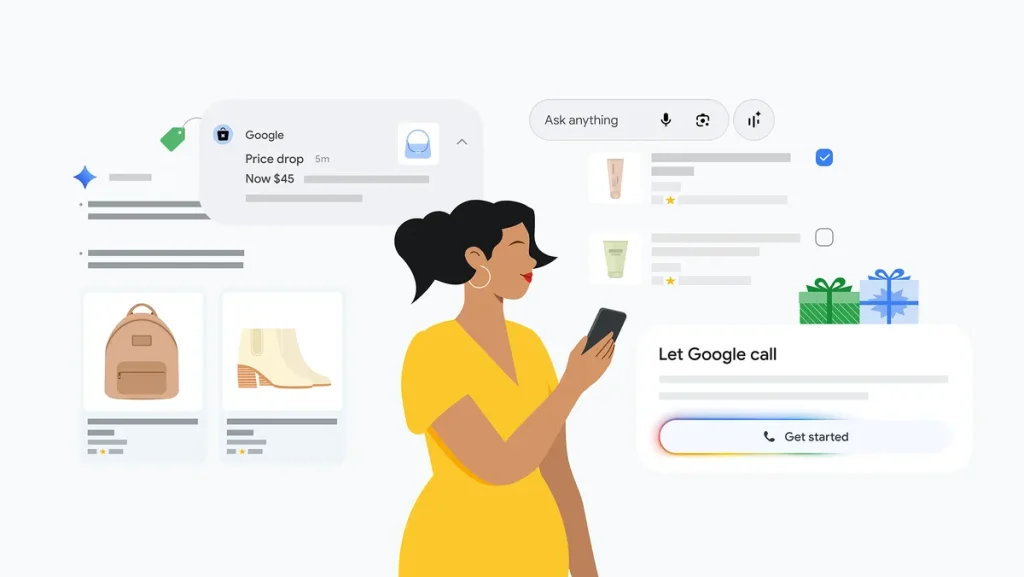
AI systems then choose which brands to show, how products are described, and what options are compared. If your brand doesn’t appear here, you lose visibility long before a shopper ever reaches your website.
What Google’s Agentic Checkout Actually Does
Google’s new agentic checkout lets Gemini handle the entire purchase flow. Here’s how it works:
- The shopper tells Google what they want: size, color, budget, timing.
- Google tracks product listings until the price or availability matches the criteria.
- Google completes the purchase on the retailer’s site using Google Pay—with user permission.
This is a major simplification of shopping. It also shifts control from the retailer to the AI assistant. You must ensure your product pages, stock data, and pricing signals are optimized—because the AI agent decides if your product is chosen or not.
AI-Powered Conversational Shopping
Google also added conversational shopping to Search’s “AI Mode.” Users can now describe what they want in natural language, and Google produces a curated set of:
- product cards
- visual previews
- comparison tables
- inventory data
This is a massive upgrade from keyword search. Retailers must now structure content around:
- benefit-driven descriptions
- use-case statements
- clear category comparisons
- structured specs and pricing
Implications for Retailers & Marketers
Here are the biggest takeaways:
- AI chooses the products. If your product content is weak, unclear, or unstructured, the AI will choose a competitor.
- Visibility now happens before the website visit. AI answers are the new “front door” to ecommerce.
- Local inventory accuracy matters. Google is using AI to call stores and verify availability.
- Real-time price readiness is critical. If your offer doesn’t trigger agentic checkout conditions, you miss the conversion moment.
Practical Actions to Stay Visible
1. Optimize Product Content for AI Extraction
Include structured specs, use-case language, comparison blocks, and clear descriptions.
2. Submit Complete, Real-Time Product Feeds
Ensure stock levels, shipping timelines, pricing, and variant data are accurate.
3. Enable Google Pay & Structured Checkout Readiness
Agentic checkout requires frictionless processing.
4. Review Local Inventory Ads and Store APIs
Features like “call store” depend on clean local inventory data.
5. Track Your AI Visibility
Use AI-visibility monitoring tools to see which products are being recommended inside AI assistants.
FAQ
What is Google’s agentic checkout
It’s Google’s new AI-driven checkout that can complete purchases on your behalf once your criteria are met.
Which retailers are included
Wayfair, Chewy, and selected Shopify merchants are among the first.
Does this replace traditional search
No—but it adds an entirely new layer where visibility must be earned.
The takeaway: AI shopping is here, and the retailers who adapt quickly will gain a major competitive advantage this holiday season and beyond.