Most Cited Domains In Google AI Overviews Reveal What Google Really Values
Google AI Overviews are quietly redefining what online authority looks like. Instead of only rewarding polished search engine friendly pages, Google AI is now surfacing content from places where real people talk, share experience, and challenge ideas in public.
Fresh research from Semrush and VisibleIQ examined which domains are cited most often inside Google AI Overviews. The results are very revealing for any search strategist or content marketer who wants to stay visible in an artificial intelligence first world.
Index
- What This New Data Shows
- Why Community Content Now Leads
- How Google AI Is Redefining Authority
- From SEO To GEO Generative Engine Optimization
- Practical Strategies To Earn AI Mentions
- What This Means For Brands And Publishers
- Frequently Asked Questions
What This New Data Shows
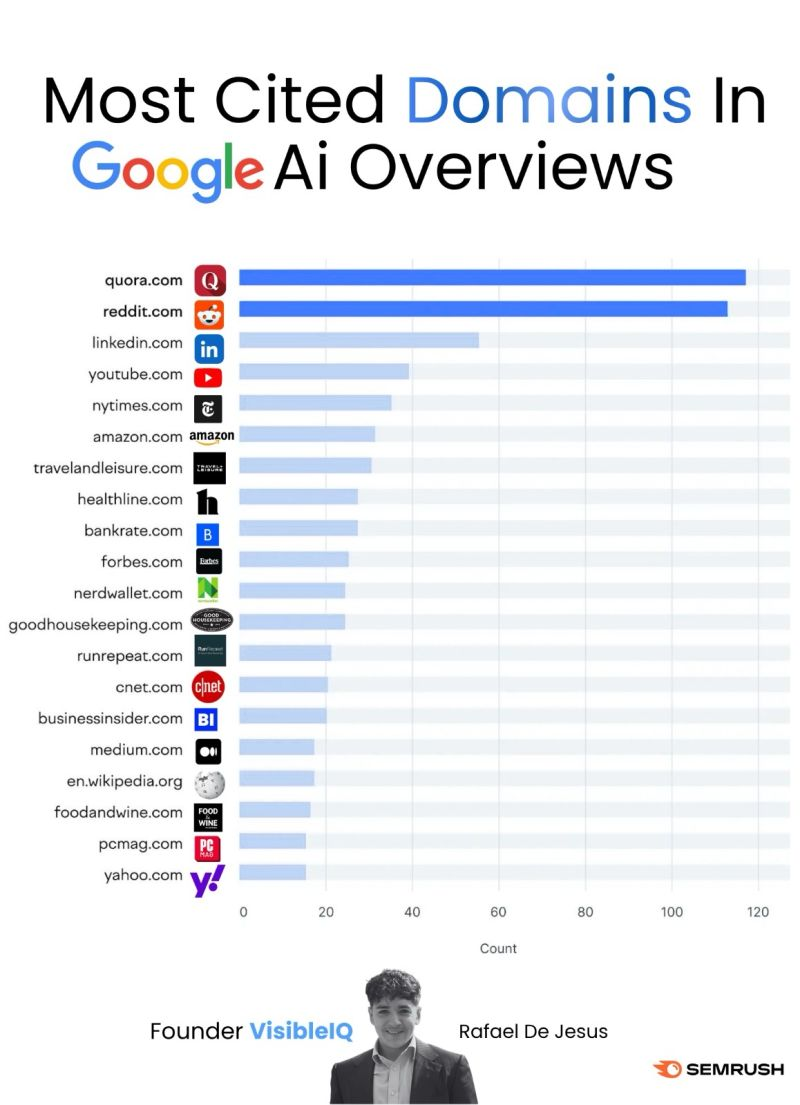
The chart above looks at the domains most often cited as sources in Google AI Overviews. At the top you see two clear leaders: quora.com and reddit.com. After those come large platforms such as linkedin.com, youtube.com, and nytimes.com, followed by trusted information brands like Amazon, Healthline, Nerdwallet, Forbes, Business Insider, and others.
This mix tells a clear story. Google AI is drawing heavily from a blend of community spaces, professional networks, and editorial brands that combine expertise with active discussion.
Key observations from the chart
- Quora and Reddit are the top two sources by a wide margin.
- LinkedIn and YouTube appear high on the list which reflects professional expertise and creator led education.
- Traditional news and information brands such as The New York Times, Forbes, Healthline, and Wikipedia are still very present.
- The overall pattern favors domains where many voices contribute and where content is actively discussed and evaluated.
In other words Google AI is not simply lifting information from static brochure style sites. It prefers places where knowledge is debated and refined in public.
Why Community Content Now Leads
Quora and Reddit are both built around open conversation. Users ask questions, share personal stories, challenge each other, and vote up the most useful replies. That makes these platforms an enormous reservoir of real experience and practical advice.
For a system like Google AI that is trained to answer messy human questions this kind of content is extremely attractive. It is rich in nuance, covers long tail scenarios, and carries natural signals of quality such as upvotes, comments, and reputation scores.
This tells us that Google AI is prioritising:
- Authentic community driven content where many people have weighed in.
- First hand experience and lived stories rather than generic summary text.
- Dialog and debate which help the model see different sides of a problem.
If your content strategy is still built only around polished marketing pages you may be missing the kind of signals that matter most for AI Overviews.
How Google AI Is Redefining Authority
Traditional search authority used to be about backlinks and brand age. With AI Overviews the picture is more complex. Authority now looks like a blend of:
- Evidence that real people are engaging with your content.
- Clear association with experts, practitioners, and professionals.
- Signals that your information has been reviewed, tested, or discussed in public.
That is why you see LinkedIn and YouTube appear so high in the citation chart. Both platforms are full of named professionals sharing their knowledge on camera or under their real identity. Google can connect that content with real world credentials and social proof.
At the same time established publishers still matter. The New York Times, Healthline, Bankrate, Forbes, and other editorial brands remain important anchors. They bring rigorous review processes and fact checking which support the E E A T concept in Google guidelines: Experience, Expertise, Authoritativeness, and Trustworthiness.
From SEO To GEO Generative Engine Optimization
All of this sits inside a larger shift from classic Search Engine Optimization to what many practitioners now call Generative Engine Optimization or GEO.
SEO asked a simple question. How do we move our page to the top of the results for a given query. GEO asks a different question. How do we earn a place as a cited source inside the answer that an artificial intelligence gives.
That difference has big implications for strategy.
- Instead of chasing one exact position you focus on earning credible mentions across many generative experiences such as ChatGPT, Perplexity, Google AI Overviews, and Copilot.
- Instead of only optimising for one set of keywords you design content for clusters of related questions and conversational prompts.
- Instead of producing thin listicles you invest in deep, expert driven, experience rich pieces that AI will want to quote.
The takeaway from the Semrush chart is clear. The brands that build visible presence in community spaces and expert networks are already ahead in this GEO world.
Practical Strategies To Earn AI Mentions
If you want your site to appear more often in Google AI Overviews and other generative experiences you need to think beyond your own domain. Here are practical moves that align with the pattern we see in the citation data.
Invest in real expertise content
- Feature named authors with real credentials and experience.
- Use case studies, experiments, and step by step breakdowns instead of generic advice.
- Answer the specific questions your audience would ask in a chat window, not only the high volume keywords.
Show up where conversations already happen
- Participate thoughtfully in relevant subreddits and Quora topics. Share real insight, not promotional copy.
- Use LinkedIn to publish thought leadership articles and commentary that signal authority in your vertical.
- Create YouTube videos that walk through problems in detail so that AI systems can see and reference your explanations.
Structure your own site for generative engines
- Use clear headings that mirror natural questions for example “What is Google AI Overviews” or “How can brands earn citations from AI.”
- Add FAQ sections and schema so that your answers are easy to extract.
- Write in a natural conversational style that matches how people speak to AI assistants.
All of these steps make your brand more attractive to generative systems which are constantly searching for rich, trustworthy, and clearly structured sources to quote.
What This Means For Brands And Publishers
The single most important insight from this data set is simple. The new visibility game is about earning the best mentions, not chasing positions.
Ranking first for a search result matters less if the user never scrolls and instead reads the AI Overview at the top. What matters now is whether that overview cites you as a source and whether your domain is visible as a trusted authority in the answer.
Brands that want to stay relevant need to ask themselves.
- Are we contributing knowledge in the communities where people ask real questions.
- Does our site demonstrate live experience, not just recycled information.
- Can Google AI easily understand and extract our answers when it builds an overview.
The companies that say yes to those questions will be the ones users actually see in an artificial intelligence first world.
Source: Semrush and Rafael De Jesus, Founder of VisibleIQ. You can find the original analysis on the Semrush blog.
Frequently Asked Questions
What are Google AI Overviews
Google AI Overviews are summaries that appear at the top of some search results. They use large language models to answer the user query directly and then cite a small set of web pages as supporting sources. Instead of only showing a list of links Google now explains the answer in natural language and links to the content it used.
Why are Quora and Reddit cited so often
Quora and Reddit are full of real conversations where people share stories, test ideas, and vote on useful answers. These discussions provide context, nuance, and first hand experience. Google AI recognises that richness and treats it as strong evidence when building an overview which is why those communities receive so many citations.
Does this mean classic SEO no longer matters
Classic SEO still matters because search engines continue to show organic results and those pages often become sources for AI Overviews. However it is no longer the whole picture. Generative Engine Optimization adds a new layer where brands must also think about how their content appears inside AI answers, not only where they rank in the list.
What is Generative Engine Optimization GEO
Generative Engine Optimization is the practice of optimising content and brand presence for artificial intelligence systems that generate answers. It involves creating expert and experience rich material, making that material easy for models to parse, and earning citations across chat assistants and AI powered search experiences.
How can a brand increase its chances of being cited by AI
Brands can increase their chances by publishing high quality expert content, participating in community platforms where real discussion happens, and structuring their pages with clear questions, answers, and FAQ schema. Monitoring AI visibility and refining content based on what assistants actually surface is becoming an essential part of modern search strategy.