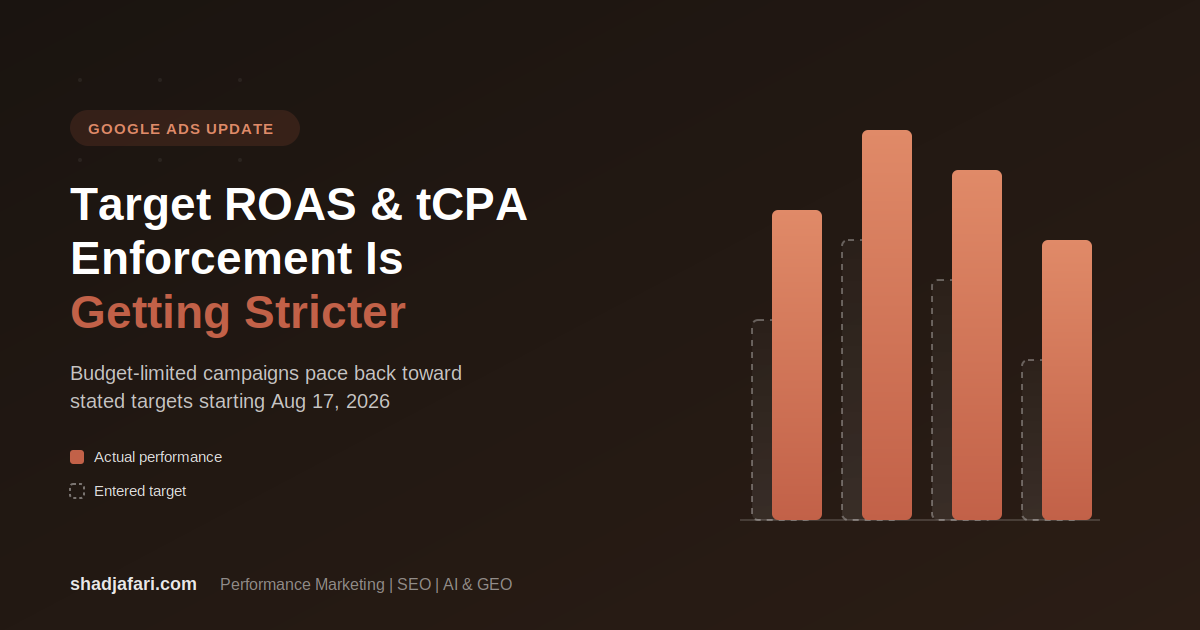
Google Ads Is Tightening Target ROAS & Target CPA Enforcement: Here’s What Advertisers Need to Know
Why Budget-Limited Campaigns Are About to Behave Differently
Article Index
- Introduction
- The Bigger Shift in Bidding
- Why This Update Matters
- What’s Actually Changing
- How to Prepare Before August 17
- Best Practices
- Challenges
- Future Outlook
- FAQ
Introduction
Starting Monday, August 17, 2026, Google is rolling out a meaningful enforcement change for Target ROAS (tROAS) and Target CPA (tCPA) bid strategies. Campaigns that are “Limited by budget” will begin optimizing more strictly toward the target you’ve actually entered, instead of continuing to run at whatever efficiency they’ve quietly drifted to. If your budget-limited campaigns are currently outperforming their stated targets, expect performance to start pacing back toward the number in the account unless you update it first.
The Bigger Shift in Bidding
For a while now, budget-constrained target-based campaigns have had some room to overdeliver on efficiency. A campaign set to a 5.5x ROAS target could quietly run at 6.8x, and Google would mostly let it. That gap between “target entered” and “target actually achieved” is exactly what this update closes. Google’s Smart Bidding systems are moving toward stricter, more literal target enforcement, a pattern we’re seeing across several bidding updates this year, not just this one.
Why This Update Matters
Here’s why advertisers running target-based strategies should pay attention:
- Campaigns overperforming their target are likely being conservative, bidding cautiously and capturing only the safest conversions instead of scaling volume.
- Once enforcement tightens, those campaigns will pace harder toward the entered target, which can shift cost, bid behavior, and volume noticeably.
- Any target that no longer reflects your real business goals is exposed the moment this rolls out.
- Accounts with several budget-limited, high-performing campaigns are the most likely to feel this in the first week.
What’s Actually Changing
- Applies specifically to Target ROAS and Target CPA strategies.
- Only affects campaigns marked “Limited by budget.”
- Google will optimize more consistently toward the entered target rather than the actual achieved performance.
- Overperforming campaigns should expect pacing to shift toward the stated goal starting August 17.
- No action is needed for campaigns whose target already reflects current performance.
Source:
Official Google Ads Help: Target ROAS & Target CPA Bidding Update
How to Prepare Before August 17
- Pull a report of all target-based campaigns that are budget-limited and near or above 100% budget utilization.
- Compare each campaign’s entered target against its actual ROAS or CPA to find the size of the gap.
- For campaigns with a large gap, open Recommendations → Bidding → Bid Target Adjustment Tool and apply the suggested target to lock in current efficiency.
- For your strongest performers, consider raising or uncapping daily budgets so the campaign can scale predictably instead of just getting pulled back.
- Re-check performance the week of August 17 to confirm campaigns are pacing where you expect.
Best Practices
- Prioritize campaigns with the widest gap between target and actual performance first, they’re the most exposed.
- Don’t blanket-apply the Bid Target Adjustment Tool without reviewing each campaign; some overperformance is worth protecting rather than “correcting.”
- Pair target updates with a budget review. A tighter target with a capped budget can still leave volume on the table.
- Document your target changes so you have a clean before/after to evaluate post-August 17.
Challenges
- Campaigns with volatile or seasonal performance may show a misleading target-vs-actual gap if measured over the wrong date range.
- Aggressively loosening targets to “protect” overperformance can erode margin if applied too broadly.
- Multi-account (MCC) management makes this easy to miss unless you’re actively auditing budget-limited campaigns across every client or brand.
Future Outlook
This fits a broader pattern of Google pushing Smart Bidding toward tighter, more literal target enforcement across both lead-gen and ecommerce accounts. Advertisers who treat their entered targets as a living number, reviewed regularly instead of set once and forgotten, will adapt to these changes faster and with less disruption.
Frequently Asked Questions
What triggers this change?
Any Target ROAS or Target CPA campaign marked “Limited by budget” that is currently performing above (better than) its stated target.
Will this increase my costs?
Not directly. It changes how aggressively the algorithm bids to hit your stated target. For overperforming campaigns, this usually means more volume at your target efficiency, not a higher cost per conversion.
Do I need to do anything if my targets are already accurate?
No. If your entered target closely matches actual performance, this change shouldn’t have a noticeable effect.
Where can I fix my targets in bulk?
Google Ads → Recommendations → Bidding → Bid Target Adjustment Tool lets you apply updated targets in one click per campaign.