Shopify Agents Explained: AI Commerce, Conversational Checkout, and GEO Strategy for Ecommerce
AI Overview: What You Need to Know
Shopify Agents enable AI tools like ChatGPT and Gemini to discover products, compare options, and complete purchases directly inside conversations. This shifts ecommerce from websites to AI-driven interfaces, where structured product data, feeds, and semantic SEO determine visibility. Brands that optimize for AI discovery (GEO) will win, while those relying only on traditional websites will lose visibility and conversions.
Table of Contents
- What Are Shopify Agents
- How Shopify Agents Work
- Official Shopify Documentation
- Why This Matters for Ecommerce Brands
- How This Impacts Growth for DTC Brands
- Impact on SEO and AI Visibility (GEO)
- What Brands Should Do Now
- The Future of Conversational Commerce
- FAQs
What Are Shopify Agents
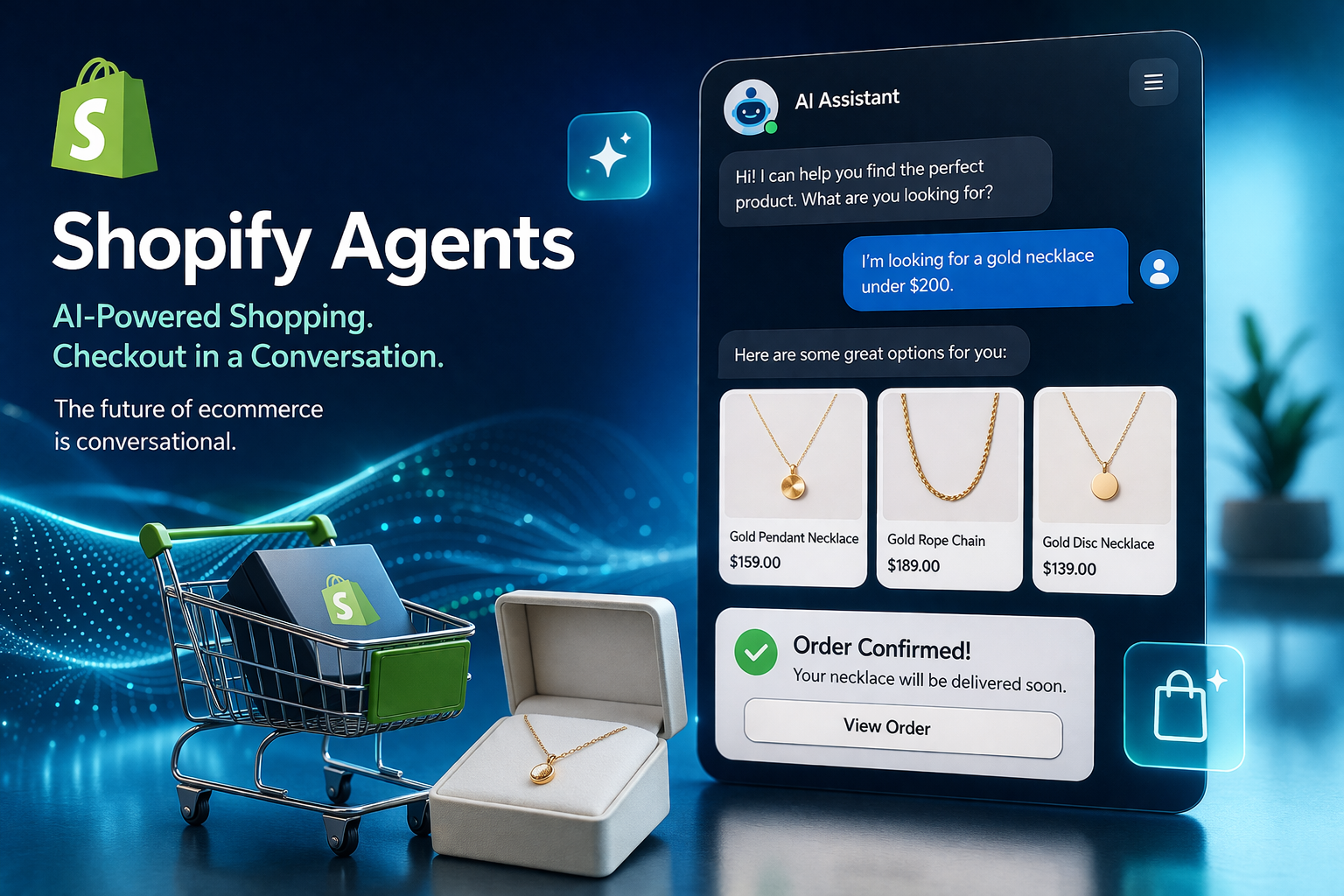
Shopify Agents are AI-powered systems that allow external AI platforms to interact directly with Shopify stores. These agents can search product catalogs, evaluate options, and complete purchases on behalf of users.
This represents a major shift in ecommerce behavior. Instead of browsing websites, users can simply ask an AI assistant:
“Find me a gold necklace under $200 and buy it.”
The AI agent handles discovery, comparison, and checkout without requiring the user to visit the website.
How Shopify Agents Work
Shopify Agents operate through a combination of APIs, structured data, and secure transaction layers.
- Product Discovery: AI queries structured product data from Shopify catalogs
- Decision Engine: AI evaluates products based on price, attributes, and relevance
- Cart + Checkout: Items are added and purchased within the AI interface
- Identity + Payments: Secure authentication and payment infrastructure complete the transaction
This removes friction and compresses the entire funnel into a single interaction.
Official Shopify Documentation
Shopify has released technical documentation outlining how developers and brands can integrate with AI agents.
👉 Shopify Agents Developer Documentation
This includes APIs, tools, and frameworks that allow AI systems to interact with storefronts programmatically.
Why This Matters for Ecommerce Brands
This shift fundamentally changes how customers are acquired.
Historically, brands relied on:
- Search rankings
- Paid traffic
- Landing page optimization
Now, the decision-making layer is controlled by AI.
If your product is not selected by the AI, you are invisible to the customer.
This introduces a new competitive layer where:
- Data quality matters more than design
- Clarity beats creativity
- Structure beats aesthetics
How This Impacts Growth for DTC Brands
For ecommerce brands in the $50M–$500M range, this creates both risk and opportunity.
Risks:
- Loss of direct traffic as AI intermediates discovery
- Higher competition within AI recommendation layers
- Reduced brand differentiation if data is not strong
Opportunities:
- New acquisition channel through AI assistants
- Higher conversion rates due to reduced friction
- Better matching of products to user intent
Brands that adapt early will gain disproportionate advantage.
Impact on SEO and AI Visibility (GEO)
This is where Generative Engine Optimization (GEO) becomes critical.
Traditional SEO focused on ranking pages. GEO focuses on being selected by AI.
To win in AI-driven commerce, brands must:
- Optimize product feeds with rich attributes
- Use descriptive, intent-driven product titles
- Add FAQ content to support AI understanding
- Implement structured data (schema markup)
- Ensure consistent pricing and availability signals
AI agents prioritize clarity, completeness, and trust.
If your data is weak, competitors will be selected instead.
What Brands Should Do Now
1. Upgrade Product Data
Include materials, sizing, use cases, and differentiators in every product.
2. Optimize Merchant Center Feeds
Your feed is now a primary input for AI discovery.
3. Build AI-Friendly Content
Create FAQs, guides, and structured content that AI can extract easily.
4. Strengthen Semantic SEO
Target intent-based queries rather than just keywords.
5. Implement Full Schema Coverage
Use Product, FAQPage, Breadcrumb, and Speakable schema.
6. Improve Trust Signals
Ratings, reviews, and clear policies increase AI recommendation likelihood.
The Future of Conversational Commerce
Shopify Agents signal a shift from browsing to asking.
Users will increasingly rely on AI to:
- Discover products
- Compare options
- Complete purchases
Ecommerce websites will evolve into structured data hubs rather than primary shopping destinations.
This is the next evolution of ecommerce.
Frequently Asked Questions
What are Shopify Agents?
Shopify Agents are AI systems that allow AI tools to search, evaluate, and purchase products directly from Shopify stores.
Do Shopify Agents replace ecommerce websites?
No, but they reduce reliance on websites by enabling direct AI-based transactions.
How do Shopify Agents impact SEO?
They shift SEO toward structured data, feeds, and AI-friendly content rather than just rankings.
What is GEO in ecommerce?
GEO (Generative Engine Optimization) is optimizing content and data for AI discovery and recommendation.
How can brands prepare?
By improving product data, feeds, schema, and semantic content strategies.